Great microcopy rarely starts in a design file. It starts in a real conversation. A user explaining what confused them. A pause before clicking. A sentence that begins with I thought this meant something else. Those unscripted moments contain the language your interface has been missing.
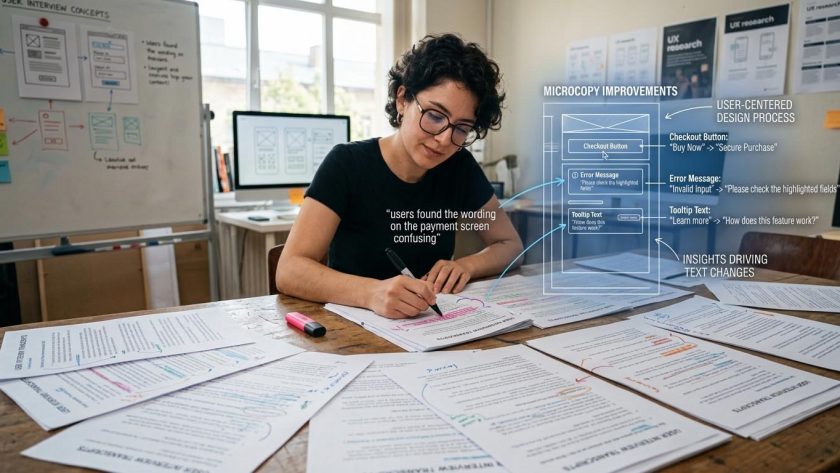
User interviews capture how people actually describe their goals and frustrations. Once those sessions are documented through accurate interview transcription, the raw material becomes searchable and scannable. Patterns surface. Repeated phrases stand out. Emotional signals become visible instead of buried in audio recordings.
From there, the work shifts from listening to shaping. Instead of inventing button labels or error messages from scratch, you begin with real words. That subtle shift changes the tone of your entire product.
Quick Summary
- Interview transcripts reveal authentic user language.
- Repeated phrases highlight friction points.
- Real wording improves onboarding, validation, and confirmations.
- Research grounded microcopy builds trust.
Why Real Conversations Produce Better Interface Text
When people speak naturally, they rarely use polished marketing language. They explain things in direct, sometimes messy ways. That directness is valuable. It shows you how they interpret your interface without filters.
For example, a participant might say, I was afraid to click that because I did not know what would happen. That sentence contains anxiety and uncertainty. It signals an opportunity for reassurance. A short line of helper text can reduce that tension immediately.
If you compare that to copy written in isolation, the difference is clear. Invented text often sounds instructional. Interview based text sounds supportive because it mirrors real cognitive patterns.
Turning Spoken Language Into Structured Insight
Audio recordings are rich, but they are difficult to analyze at scale. Converting recordings into written format allows you to scan for recurring words and emotional peaks. Many UX teams routinely convert audio to text before synthesis sessions so that every quote can be reviewed line by line.
Once transcripts are available, read them without editing. Highlight phrases that appear multiple times. Pay attention to sentences that begin with I expected, I assumed, or I did not realize. Those openers often signal mismatches between interface intention and user perception.
This method pairs well with structured UX writing practices such as testing small text variations in prototypes. Insights from resources like microcopy testing in prototypes help translate qualitative findings into measurable improvements.
From Themes to Microcopy Components
After reviewing transcripts, cluster observations into themes. Confusion. Motivation. Anxiety. Impatience. Each theme corresponds to a type of microcopy.
Confusion often maps to labels and helper text. Anxiety maps to reassurance near sensitive actions. Motivation influences call to action phrasing. Impatience affects onboarding length and progress indicators.
For example, if users repeatedly say, I just want to get started quickly, your onboarding flow should reflect that urgency. A concise primary action and minimal explanatory text may outperform a lengthy welcome screen. Guidance from pieces such as effective onboarding screen design can reinforce those adjustments while keeping the experience coherent.
Mapping Interview Signals to Interface Improvements
| Interview Signal | What It Reveals | Microcopy Adjustment |
|---|---|---|
| I thought this was saved | Unclear system feedback | Add visible save confirmation |
| I do not know what this means | Ambiguous terminology | Rewrite labels in plain language |
| I was worried about privacy | Trust concern | Add reassurance near input fields |
This mapping keeps your writing aligned with user evidence. Each change has a traceable origin in real speech.
Balancing Authentic Voice With Brevity
Interview language is valuable, but microcopy must remain concise. Spoken sentences often contain filler words and repetition. Editing is necessary, but the emotional core should remain intact.
There are three practical steps to refine transcript language.
1. Remove fillers and hesitation markers while keeping intent.
2. Shorten long phrases into clear, direct statements.
3. Align tone with your brand without losing user phrasing.
This balance ensures the interface sounds natural rather than theatrical. It feels grounded because it is rooted in actual user expression.
Where Research Based Microcopy Has the Greatest Impact
Interview driven microcopy improves onboarding, error states, checkout flows, and confirmation screens. These areas often carry emotional weight. Small wording changes can reduce friction immediately.
- Onboarding screens that reflect first time uncertainty.
- Error messages that explain what went wrong in user terms.
- Validation hints that anticipate common misunderstandings.
- Confirmation messages that reinforce successful actions.
Usability research from organizations such as digital.gov emphasizes clarity and plain language in digital interfaces. Interview transcripts naturally surface plain language because users speak in it. Aligning microcopy with that reality improves comprehension across diverse audiences.
Let Real Language Shape the Product Voice
An interface always communicates something. It guides. It reassures. It warns. If that voice feels disconnected from real people, trust weakens. Interview transcripts reconnect your product with lived experience.
By systematically reviewing transcripts, identifying repeated phrases, and translating those phrases into concise interface text, you create microcopy that feels natural. Not decorative. Not inflated. Just aligned with how people describe their own needs.
The next time you finish a research round, treat the transcript as more than documentation. It is a blueprint for clearer labels, kinder error messages, and onboarding flows that reflect actual expectations. When your product echoes your users’ words, clarity stops feeling forced and starts feeling intuitive.